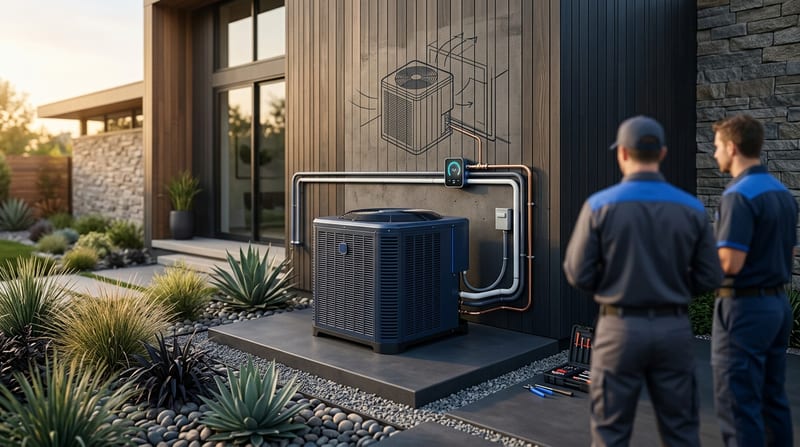
5 Ton AC Unit Installed Price: What You Should Actually Expect to Pay in 2026
A 5 ton system is the biggest residential AC unit most homes will ever need. It handles 2,500 to 3,000 square feet, and it isn't cheap to install. I'm going to give you real numbers, tell you where contractors pad the bill, and explain why doing this yourself is one of the worst decisions you can make.
How Much Does a 5 Ton AC Unit Cost Installed in 2026?
Equipment alone for a 5 ton central AC unit runs roughly $3,500 to $5,000 depending on efficiency tier. That isn't your installed price. Your installed price is $9,500 to $16,000 for a straight replacement in most markets. Average cost of central AC installation ranged from $5,900 to $11,700 in 2024 (Bankrate), and 5 ton systems sit at the top of that range because they require heavier electrical circuits, more refrigerant, and longer labor hours.
In 2026, per square foot costs for a full system installation run $3.50 to $7.50. On a 2,800 square foot house that's $9,800 to $21,000 depending on complexity. The national average AC unit installation cost was $7,081 in 2023 (Angi), but a 5 ton system isn't average. It's the heavy end of residential work.
Here's what changed this year. The EPA's AIM Act cut HFC production allowances by 40% effective January 2025 (EPA), pushing new R-454B equipment costs up 5 to 12 percent. But contractors still sitting on R-410A inventory are discounting it 15 to 20 percent to clear warehouse space. That creates a real decision point. Budget now with R-410A or pay more for the refrigerant that will be serviceable for decades. Either way, don't let anyone quote you using legacy SEER ratings. The SEER2 standard has been in effect since January 2023 and any contractor still quoting old SEER numbers either doesn't know what he is doing or hopes you don't.
To see how these national figures translate to your metro area, check prices in your city.
What Is and Is Not Included in a 5 Ton Installation Quote
Here's where most homeowners get taken. Central AC equipment with basic installation ranges $4,000 to $9,000, with labor adding $1,500 to $6,000 and ductwork adjustments adding $1,000 to $5,000. A legitimate quote for a 5 ton system should list the condenser unit, evaporator coil, line set, refrigerant charge to manufacturer spec, thermostat, labor for 8 to 14 hours of work, permit fees, and disposal of the old unit.
That disposal isn't free. EPA regulations require freon recovery before any old unit gets hauled off. That costs $200 to $500 and if a contractor isn't including it, he is either eating it or planning to vent the refrigerant illegally. The EPA fined 150 contractors $1.2 million for refrigerant mishandling in 2023 alone (EPA).
"If you need ductwork, budget an additional $1,000 to $2,700 for materials and labor," says Lauren Bongard, Contributing Writer, reviewed by Robert Tschudi, Expert Reviewer. That's the floor. I've seen duct modifications on older homes run $5,000 or more when the existing system was undersized for decades.
One more thing. An estimate isn't a quote. An estimate is a non-binding number that can move. A quote is a binding price commitment. Most contractors hand you an estimate and call it a quote. Ask which one you're signing. And before you sign anything, the FTC's Cooling-Off Rule gives you 3 business days to cancel any contract of $25 or more signed in your home (FTC). Know your rights.
Before you sign, check if that quote is fair.
6 Factors That Push a 5 Ton Install Above $12,000
Ductwork. A house needing 5 tons of cooling has a lot of duct. If that duct is leaking, you're throwing money into your attic. Poor duct installation increases energy bills by 20 to 40 percent (Lawrence Berkeley National Laboratory). Your contractor should run a duct blaster test before quoting. If he doesn't mention it, that tells you something.
Electrical. A 5 ton unit draws serious amperage. Older homes may need a 240V dedicated circuit or a breaker panel upgrade. Electrical hazards in HVAC work led to 4,200 home fires annually between 2015 and 2019 (NFPA). "The real risk isn't just inefficiency; improper electrical sizing causes 40% of HVAC-related house fires we investigate," says Paul Grimwood, Fire Protection Engineer at NFPA. This isn't a place to cut corners.
SEER2 rating. Higher efficiency units cost more upfront. An 18+ SEER2 five ton system can run $12,000 to $16,000 installed (alltempsolutionsinc.com). But improperly installed central AC systems consume up to 30% more energy than properly installed ones (DOE). You can buy the most efficient unit on the market and still waste money if the install is sloppy.
Labor shortage. BLS data shows 110,000 unfilled HVAC installer positions nationally, with employment projected to grow 6% from 2022 to 2032 (BLS). That shortage drives up labor rates, especially in summer. Schedule your install in fall or late winter and you'll likely save $500 to $1,000.
Tax Credits and the Heat Pump Math Most Guides Get Wrong
Here's what nobody tells you. The IRS Section 25C tax credit for a conventional central AC unit maxes out at $600 per year. For a qualifying heat pump, it's $2,000 (IRS). That's a 233% difference.
Run the numbers. A 5 ton conventional AC installed at $10,500 minus $600 credit equals $9,900 net. A 5 ton heat pump installed at $12,000 minus $2,000 credit equals $10,000 net. For a hundred dollars more you get a system that heats and cools. If your household qualifies, the IRA's HEEHRA program provides point-of-sale rebates up to $8,000 for heat pump installations (DOE). That changes everything.
Always ask your contractor to quote both a conventional AC and a heat pump side by side. If he won't, find someone who will.
Why Professional Installation Is Not Optional on a 5 Ton System
I hear it every year. Someone wants to save $3,000 by installing their own system. On a 5 ton unit, that's the worst bet in the house.
HVAC installation errors contribute to 50% of premature system failures within 5 years (ACCA). DIY callback rates run 25% higher than professional installs (ServiceTitan). Refrigerant leaks from improper installation cause 20 to 30 percent efficiency loss (ASHRAE).
"Many homeowners underestimate the precision required for brazing refrigerant lines; a single pinhole leak can doom the entire system within months," says John Paye, Technical Director at ACCA.
"With HFC phase-down, DIYers handling R-410A without recovery certification face EPA fines up to $50,000 per incident," says Sarah Dunham, Enforcement Director at EPA Stratospheric Ozone Division.
And here's the part that really hurts. "DIY AC installs often void manufacturer warranties and lead to insurance claim denials because they bypass NATE certification standards," says Brenda H. Jackson, President of National Air Conditioning Trades Association. Your homeowner's insurance can deny a water damage claim under a negligent maintenance clause if the install wasn't done by a licensed professional. That $3,000 you saved just cost you $30,000.
How to Get the Best Price Without Getting Played
Get three binding quotes. Not estimates, and Quotes. Compare them line by line. Equipment model, SEER2 rating, labor hours, permit fees, warranty terms. If a contractor won't itemize, walk.
Time your purchase. September through November pricing runs 10 to 15 percent lower than peak summer in most markets. The R-410A clearance window is real but shrinking. Weigh the discount against the fact that R-454B is the future.
Ask what's removable from the bid. Smart thermostats, UV lights, surge protectors. You can often source these independently for less. But never negotiate away the commissioning test, the permit, or the warranty registration.
Configure your exact estimate to see city-adjusted costs before any contractor walks through your door. And if you're financing, compare HELOC vs. contractor financing because the interest rate spread can add thousands over the life of the loan.
A 5 ton AC installation is one of the biggest mechanical investments your home will ever see. Get the numbers right, get the contractor right, and get it done once. That's the only way this works.