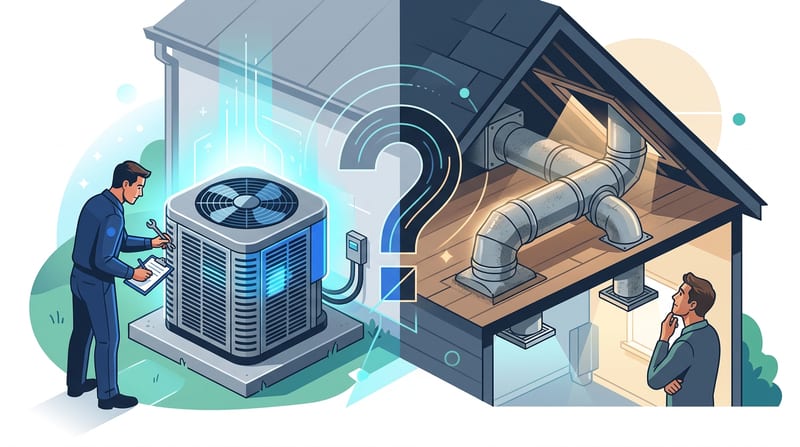
Replace AC Without Replacing Ductwork: When It Saves Thousands and When It Backfires
Many homeowners believe replacing only the AC unit while keeping existing ductwork is a simple way to cut costs. Evidence shows this decision frequently backfires when ducts are leaky, undersized, or poorly designed. Improperly installed central AC systems can consume up to 30% more energy than properly installed ones (U.S. Department of Energy (DOE), 2023). Poor duct installation increases energy bills by 20-40% in residential systems (Lawrence Berkeley National Laboratory (LBNL), 2020).
Concrete takeaway: Test your ducts before committing to an AC-only swap. One $200 measurement can prevent thousands in wasted electricity over the system’s life.
The Real Cost Gap in 2026
Central AC equipment with basic installation ranges from $4,000 to $9,000, with labor and installation adding $1,500 - $6,000. Adding new ductwork increases costs by $1,000 - $5,000 (Bankrate, 2024). New central air conditioning installation in homes without existing systems typically costs $8,500 - $19,400, with most homeowners paying between $10,500 and $15,000 including ductwork and electrical upgrades.
The national average for a full HVAC replacement sits at $7,500, ranging from $5,000 to $12,500 depending on unit type, size, brand, and labor costs. High-end central air installations for large homes with complex duct systems reach $10,000 - $15,000+.
Concrete takeaway: An AC-only replacement saves money only when existing ducts pass rigorous testing. Otherwise, the long-term efficiency losses erase the initial savings.
When Existing Ducts Can Safely Support a New AC Unit
Ducts under 15 years old that pass a duct blaster test with less than 20% leakage and were originally sized using Manual J calculations often support a new high-efficiency unit. Homes built after 2005 with sealed flex or metal ductwork frequently meet this standard.
Concrete takeaway: Age and visible condition alone don't determine compatibility. Measurement, not assumption, decides whether your ducts stay.
When Keeping Old Ducts Becomes Expensive
HVAC installation errors contribute to 50% of premature system failures within 5 years (Air Conditioning Contractors of America (ACCA), 2022). Refrigerant leaks from improper installation cause 20-30% efficiency loss per ASHRAE studies (American Society of Heating, Refrigerating and Air-Conditioning Engineers (ASHRAE), 2021). Average DIY AC repair callback rate is 25% higher than professional installs (ServiceTitan, 2023).
Concrete takeaway: Ductwork that fails static pressure or leakage tests turns a $6,000 - $9,000 AC replacement into a multi-year money pit.
Critical Diagnostics Before Any AC-Only Replacement
A duct blaster test costing $150 - $300 provides objective data on leakage. Residential air conditioning accounted for 444 billion kWh of electricity use in 2020, about 17% of total residential consumption (U.S. Energy Information Administration (EIA), 2022).
Static pressure testing reveals whether old ducts can deliver required airflow for modern SEER2 equipment. SEER2 standards test at 0.5 inches external static pressure, exposing weaknesses in older systems.
Concrete takeaway: Never accept a visual inspection alone. Demand documented duct blaster and static pressure results before approving any AC swap.
The Manual J and Duct Compatibility Problem
Manual J load calculations must match both the home’s cooling load and the existing duct system’s airflow capacity. A 3-ton system requires roughly 1,200 CFM; a 4-ton system needs 1,600 CFM. Mismatched tonnage on old ducts causes short-cycling, poor dehumidification, and early failure.
Concrete takeaway: Proper tonnage selection requires both load calculation and duct verification. Guessing tonnage based on the old unit size risks expensive premature failure.
Professional Installation Risks and Why DIY Is Particularly Dangerous Here
An estimated 162,980 fan and air conditioner-related injuries were treated in U.S. emergency departments in 2021 (U.S. Consumer Product Safety Commission (CPSC)). Ladder-related injuries, common in DIY HVAC installs, totaled 81,000 emergency visits in 2022 (U.S. Consumer Product Safety Commission (CPSC), 2022). Electrical hazards in HVAC work led to 4,200 home fires annually (2015-2019 average) (National Fire Protection Association (NFPA), 2022).
"DIY AC installs often void manufacturer warranties and lead to insurance claim denials because they bypass NATE certification standards," says Brenda H. Jackson, President of National Air Conditioning Trades Association (HVAC Insider, October 2022).
"Many homeowners underestimate the precision required for brazing refrigerant lines; a single pinhole leak can doom the entire system within months," says John Paye, Technical Director at Air Conditioning Contractors of America (ACCA Now Magazine, June 2023).
"With HFC phase-down, DIYers handling R-410A without recovery certification face EPA fines up to $50,000 per incident," says Sarah Dunham, Enforcement Director at EPA Stratospheric Ozone Division (EPA Webinar Transcript, January 2024).
Concrete takeaway: Replacing an AC unit while reusing ductwork involves refrigerant handling, electrical work, precise charging, and airflow balancing. These tasks carry safety, legal, and financial risks that make professional installation the lower-risk choice.
Efficiency Standards and Rebates Favoring Professional Work
Employment of heating, air conditioning, and refrigeration mechanics and installers is projected to grow 6% from 2022 to 2032, faster than average (U.S. Bureau of Labor Statistics (BLS), 2023-09). The EPA fined 150 contractors $1.2M for refrigerant mishandling in 2023 (Environmental Protection Agency (EPA), 2023).
Many tax credits and rebates under the Inflation Reduction Act require NATE-certified or licensed professional installation. DIY work disqualifies these incentives.
Concrete takeaway: Professional installation protects both your system performance and your eligibility for rebates and tax credits up to $2,000.
Step-by-Step Process for Safe AC Replacement With Existing Ducts
- Order a professional duct blaster test and static pressure measurement first.
- Require a Manual J load calculation that accounts for current duct capacity.
- Get three itemized bids from licensed, NATE-certified contractors.
- Verify the contract includes post-install commissioning, static pressure verification, and refrigerant charge by weight.
"Contractors see 15-20% of new installs fail first-year commissioning due to overlooked condensate drainage issues," says Mike Moore, CEO of ServiceTitan (ServiceTitan HVAC Report Launch, 2023).
Concrete takeaway: Following this sequence protects your investment and prevents the most common failure modes.
Ready to make the right call for your home? Get AC Installation Quote Online - Fast & Free from licensed professionals who will test your ducts properly.
Verify HVAC Contractor License: Avoid 2026 AC Disasters
Related Guides: